
神马
当两幅锦旗跨越千里而来:梨花教育的服务标准与人文刻度_我的网站

一 |
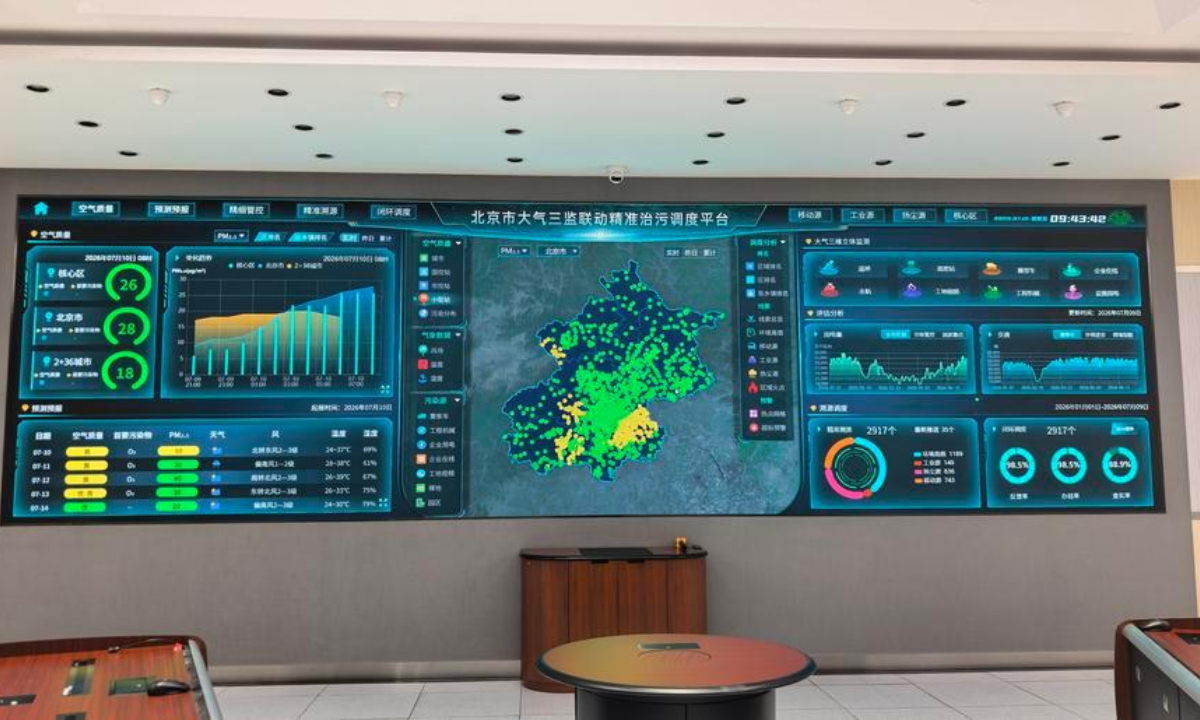
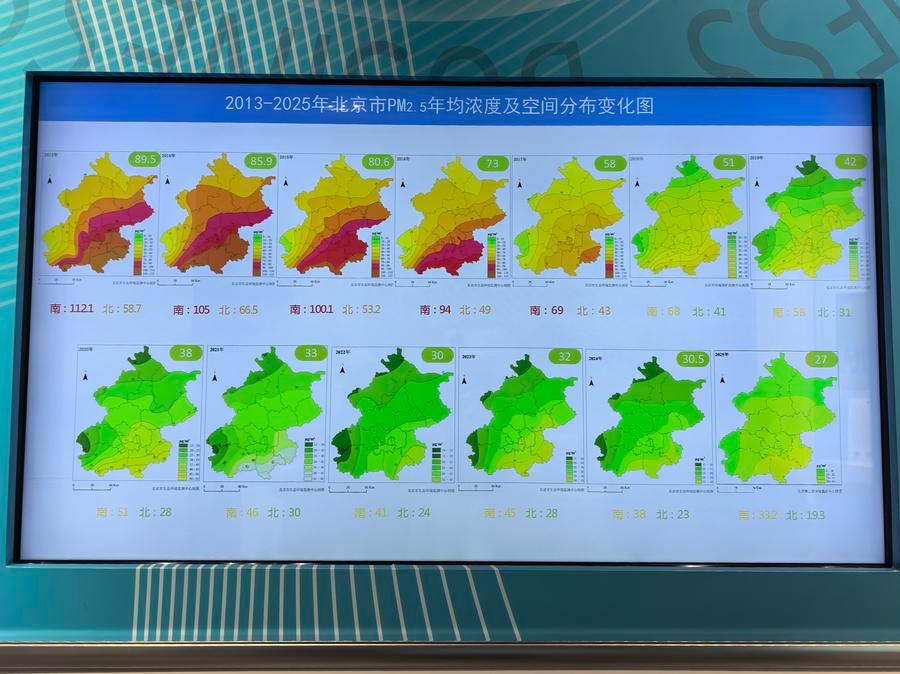
In 2025, Beijing recorded 311 days with good air quality and only one heavily polluted day, compared with 58 heavily polluted days in 2013, when the city officially began releasing PM2.5 monitoring data. The annual average PM2.5 concentration, a key indicator of air quality, fell from 89.5 micrograms per cubic meter in 2013 to 27 micrograms per cubic meter in 2025, a decline of nearly 70 percent.
The progress has drawn international attention. The United Nations Environment Programme has highlighted Beijing's experience in improving air quality as a model for other cities.
According to experts at the Beijing Municipal Ecological and Environmental Monitoring Center, the cleaner air is the result of a comprehensive system integrating environmental monitoring, scientific analysis, policymaking, regional cooperation and law enforcement -- with digital technologies now woven into every link of that chain.
MORE TARGETED APPROACH
Effective governance begins with accurate monitoring. Beijing has established a multi-level air-quality monitoring network. Figures show 35 standard monitoring stations across the city continuously measure six major pollutants, while more than 1,000 compact sensors deployed across communities and townships provide more detailed information on local air-quality variations.
The monitoring system was gradually built by the Beijing Municipal Ecological and Environmental Monitoring Center, one of China's earliest ecological and environmental monitoring institutions, responsible for monitoring Beijing's air, water, noise, soil environments and ecosystems.
The center has developed an analytical system that can identify around 125 components of PM2.5, covering most of its composition and helping researchers trace pollution sources.
"Source analysis helps us identify the major contributors to pollution at different stages, providing a scientific basis for policymakers to target key emission sources," said Li Yunting, technical director at the center.
Coordinated by the Beijing Municipal Ecology and Environment Bureau, the center has conducted four rounds of PM2.5 source analysis studies with other institutions, with results released in 2014, 2018, 2021 and 2025.
The latest analysis showed that regional transport contributed 57 percent of Beijing's PM2.5 pollution. Among local sources that accounted for the remaining 43 percent, vehicle emissions and residential sources represented the largest share of pollution, a distinctive characteristic of a major international metropolis.
The monitoring results have provided scientific support for a series of pollution-control measures. For example, Beijing has promoted new-energy vehicles to reduce transport emissions and adopted advanced techniques, including air-supported membrane structures, to control dust emissions. Meanwhile, coal combustion pollution, once a major contributor, has almost been eliminated and is no longer listed among the main sources, reflecting broader national efforts to reduce coal consumption, promote clean energy and upgrade heavily polluting industries.
With PM2.5 concentrations now at relatively low levels, further gains in air quality will depend on more targeted, science-driven approaches.
SMARTER ENVIRONMENTAL GOVERNANCE
Beyond monitoring pollution, Beijing has built a data-driven environmental governance system that links monitoring, regulation and enforcement in a closed loop from detection to action and follow-up evaluation.
Developed by the center and known as the innovative regulation-monitoring-inspection linkage model, the system integrates artificial intelligence, the Internet of Things, satellite remote sensing and vehicle-mounted monitoring technologies to pull together environmental data from multiple sources onto a unified platform.
"The system brings information that was once scattered across different departments onto a single platform," said Zhang Likun, director of the smart system division at the center, adding that this enables off-site enforcement and joint cross-sector actions involving housing, water resources and transportation, significantly improving the efficiency and precision of environmental management.
Using more than 30 intelligent algorithms, the platform automatically analyzes data and identifies potential pollution risks, based on which monitoring staff identify the most pressing problems and forward them to enforcement departments.
The approach has already drawn international attention. Clean Air Asia, an international nongovernmental organization focused on improving air quality across Asia, featured the system as a representative case study in its "China Air 2025" report. The model was also presented at the 2026 Better Air Quality Conference and recognized with the Certificate for Clean Air Best Practice Sharing.
China has integrated ecological conservation into its modernization drive. As the country speeds up efforts under the Beautiful China Initiative, Beijing's experience demonstrates how technology can support more precise, coordinated and sustainable environmental governance.
。 今年春天,两幅锦旗从不同方向寄往同一间办公室。一幅来自东北,寄件人特意叮嘱快递“包严实些”;一幅来自北京,定制时,那位女士在店里站了很久,只为挑一个最衬字的底色。锦旗上的字不同,寄件人素不相识,却指向了同一件事——梨花教育的售后服务体系,在她们最需要的时候,托住了她们。 金女士年过六旬,退休后报名了梨花教育的声乐课程,本想好好拾起年轻时搁置的爱好。

二 | 不料家中突发变故,丈夫病倒,她的时间被切割成碎片,再也无法按原计划上课。她没有选择退课,而是联系了平台售后。 让她意外的是,不到半天就有了专人回应。

三 | 工作人员没有劝她放弃,而是了解了她的作息,把课程拆解成更小的单元,让她能见缝插针地学,同时明确告知权益可以保留。

四 | 她没有中断学习,只是换了一种节奏。

五 | 来自北京的李女士是另一类情况。她零基础入门,练习中反复碰壁,慢慢开始怀疑自己是不是“年纪大了学不来”。平台同样在数小时内响应了她的反馈。售后人员没有给她空洞的安慰,而是告诉她,声音的美恰恰在于不完美——带一点沙哑、节奏不那么精准,反而更有辨识度。

六 | 这番话帮她卸下了包袱,重新找回了练习的劲头。

七 | 两件事看起来完全不同——一个需要调整学习计划,一个需要疏导心理压力——但背后是同一套体系在运转。2026年初,梨花教育通过了国家市场监督管理总局CNCA认证的五星级售后服务认证,这意味着每个用户的诉求,都能在4小时内得到响应、48小时内拿到解决方案。更关键的是,平台的服务人员经过专业培训持证上岗,能在标准框架内做出有人情味的判断。不是机械地执行流程,而是在流程中看见每一个具体的、活生生的人。

八 | 对中老年用户来说,选择一堂文化素养课,买的不仅是内容,更是一份“万一我撑不下去,有人会拉我一把”的安心。梨花教育用两幅锦旗和一套标准化的服务体系,给出了这份安心。【广告】免责声明:本内容为广告,相关素材由广告主提供,本文仅代表作者个人观点,与本网无关。本网发布目的在于传递更多信息,并不代表本网赞同其观点和对其真实性负责,广告内容仅供读者参考,请自行核实相关内容。
Current article:http://nfgqw.hunyoduozuiaopoulun.buzz/12vpc9/cheop.html
Published on:00:24:13
- 腾薪资!骑士将用延伸条款裁掉白魔 哈登年薪预计3200万-3300万
- セブン-イレブンから1年ぶりに登場!! 何度も食べたくなる美味しさ「話題のお弁当」がコチラです!!
- 公安机关公布4起编造传播涉台风等网络谣言典型案例
- Alia Bhatt reflects on her decade-long career at the Red Sea Film Festival
- ADP: Employers Add Fewer Jobs Than Expected as Hospitality Sector Slows
- 大谷翔平のさりげない一言が「さすがすぎる」 “不在”に示した覚悟「本当にチーム思い」
- 下赛季蜕变?青岛后卫段昂君在美国与詹姆斯&马克西训练师特训
- 京东秒送
- 冲刺四季度丨高新区:项目建设提档加速 助力“百业助剂”早日投产
- How Far Will Montana’s Push to Remove Lead from School Drinking Water Go?